Summoned From Obscurity: Reflections on the Colonial Depot
By Tamarah Kerr de Haan, on the work of Mirelle van Tulder
![]()
What are we even witnessing here…I wondered while walking past these countless relational materials. As my eyes followed the ocean-blue metal frames stretching into the distance, the question itself seemed quite hopeless in its formulation. Only when the wheel attached to each rack is manually turned does the metre-long passage between the racks appear, and even more vessels emerge from their enduring enclosure. The ocean-blue racks form the skeletal foundation of the depot, assembling the shelves, each bearing the weight of histories, memories, dispossession, dis- and non-placement. ‘Object’ upon ‘object’, each tagged with minimal description: country of origin, an alphanumeric code, a barcode, and words such as ‘statue’, ‘mask’, ‘head cover’, ‘ancestral effigy’, ‘human skeletal remains from excavation in [...]’…
‘We die but are not dead. I am afraid.
Being Part European, (the film) sheds light on what is deliberately kept in the dark, making visible an otherwise concealed infrastructure that presents a physical architecture of colonial persistence. Through the film, we witness not colonial history but the ongoingness of coloniality itself. It exposes how these depots constitute not merely storage facilities, but are also active monuments to an epistemic order that obscures whether these cultural forms were brought by missionaries, civil servants, or military expeditions. It obscures whether they were gifted, traded, looted, or stolen. In doing so, this obfuscation of provenance reaffirms the colonial refashioning of cultural theft as preservation, displacement as protection, and silencing as curation. Through the lens of van Tulder’s camera, we therefore confront not only the objectification of lifeforms but also the hidden grammar of power that arranges them.
A longer version of this essay was first published in Emptying the Shelves, Roots to Fruits & Framer Framed, 2025.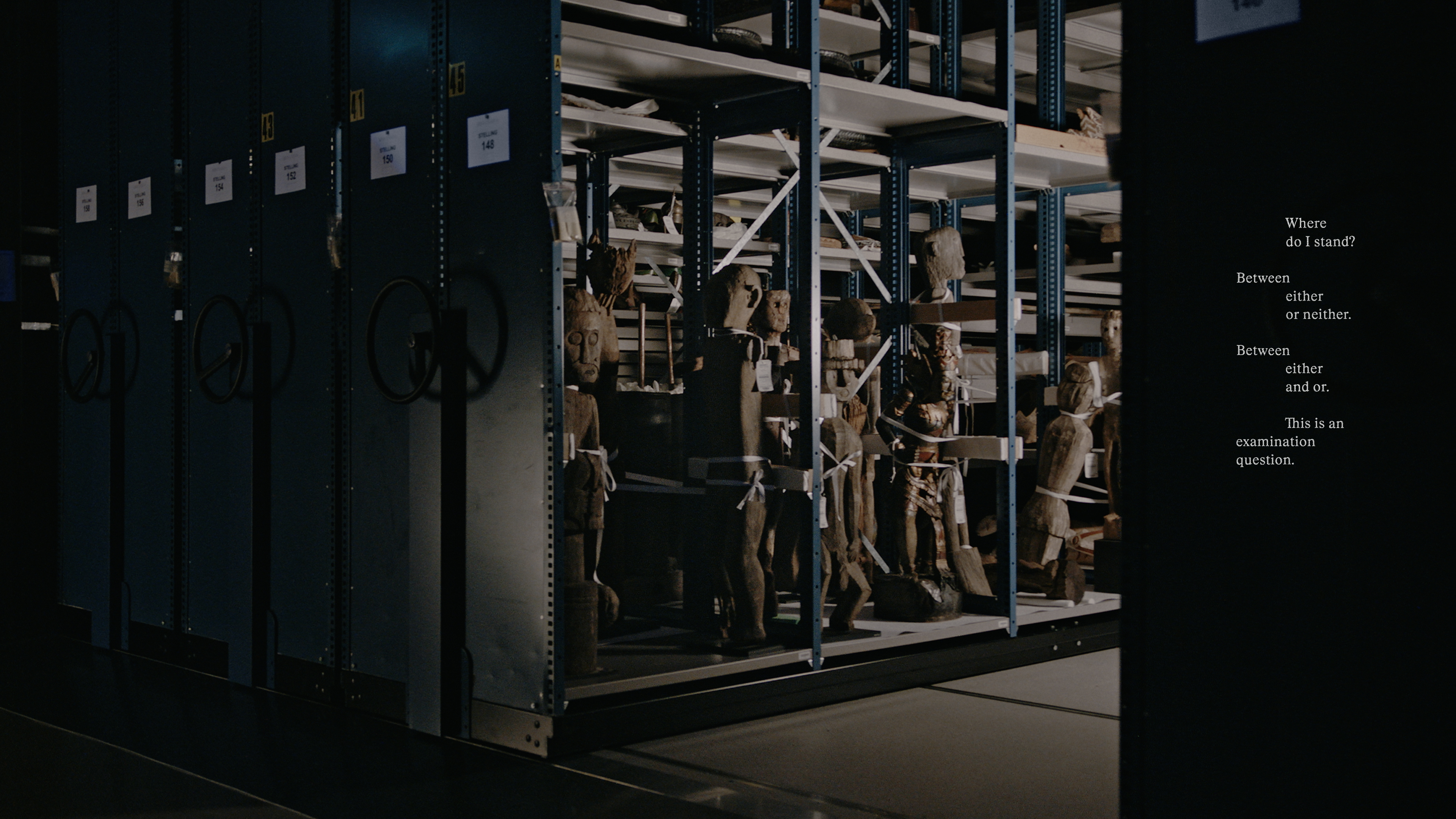
What are we even witnessing here…I wondered while walking past these countless relational materials. As my eyes followed the ocean-blue metal frames stretching into the distance, the question itself seemed quite hopeless in its formulation. Only when the wheel attached to each rack is manually turned does the metre-long passage between the racks appear, and even more vessels emerge from their enduring enclosure. The ocean-blue racks form the skeletal foundation of the depot, assembling the shelves, each bearing the weight of histories, memories, dispossession, dis- and non-placement. ‘Object’ upon ‘object’, each tagged with minimal description: country of origin, an alphanumeric code, a barcode, and words such as ‘statue’, ‘mask’, ‘head cover’, ‘ancestral effigy’, ‘human skeletal remains from excavation in [...]’…
Upon entering the first building, I could already sense a visual crisis awaiting me (knowing there were three more to come). By the time we reached the third building, I was already undone, not by what was seen but by the impossibility of seeing. After the overwhelming visibility in the first and second buildings, a paradox emerged here in the third building. Suddenly, the flood of vision seemed to drown perception itself. It was a lot to take in, too much for just an afternoon visit. The excess of materiality began to create an incomprehensible void, not only in the spatiality of the warehouse but also within myself. As I moved through the third warehouse, having now wandered three-quarters of the 4,000-square-metre depot, I no longer knew where to look. There were just so many forms, so many shapes, smells, and silences… The air in these spaces felt thick with something unspeakable. It was here, in this third building, that I realised each building carried its distinct scent. I still remember the pungent, earthy food-like odour that lingered in the air of one of the buildings. It was a scent shaped by the many artefacts crafted from cloves. I remember how, after I commented on the smell, the depot worker guiding us said matter-of-factly, ‘This building smells like Indonesia.’
After viewing Mirelle van Tulder’s 2024 short documentary, Being Part European, filmed inside the depot of the Dutch National Museum of World Cultures (Wereldmuseum), I was deeply affected by what she had created. For the first time, someone was granted access to film within these secretive walls. Mirelle undertook the crucial task of uncovering who/what is actually being referred to when we speak of colonial art restitution. The film visualises that the conversation extends far beyond what museums display publicly, as entire nonworlds exist, clustered with material presences kept in silence.
When Mirelle asked if I wanted to visit the depot for this essay, I had no idea what to expect. I had already watched the film several times and seen images of what lies hidden there while browsing through the online archive, but nothing could have prepared me for the vastness of what I encountered. Entering the depot was an overwhelming experience. It was an encounter marked by the limits of vision and the opening of something else.
In the presence of these ancestral traces, a quiet hope stirred in me, even as the setting itself evoked a sense of hopelessness and of feeling trapped. I felt discombobulated, unable to make sense of myself or these material, perhaps spiritual, witnesses. Towards the end of my visit, without thinking, while walking around the fourth and final building of the depot, I began to hum… softly, instinctively. I sang a song of waters and freedom, which I had first heard about a year prior in a one-night live performance and which has stayed with me ever since. The sounds of this choir deeply engaged with the remembrance of this tear in the world—that is, the Maafa4, the horrific disaster of the Middle Passage, and the continuation of its wake, in other words, the enduring afterlife of its violence in the present.
In this depot, one does not so much enter as become entangled. Here, in this space—a confluence of silences and shadows, structures that conceal chaos, relics (that have survived) whose origins disobey accurate naming—colonial time coils, not as memory but as omission. What is possessed is also disavowed. In the colonial depot, sovereignty flickers…; claimed, fragmented, withheld. The place is structured yet chaotic, filled with material presences both foreign and ancient, all cluttered on shelves, hidden between others. What is evident is that here lie belongings, some of which require highly skilled craftsmanship, alongside artistic expressions of artistic mastery, or perhaps once sacred vessels used in ritual and spiritual practice. Yet today, it is the unknowable that hums beneath the silence, filling the room with its loud weight.
In each of these four warehouses in ’s-Gravenzande, the Netherlands, one quarter of at least 450.000 cultural forms are sequestered from the world, from narrativisation, from cultural memory, from be-longing. The institution hides/stores them in this distant nonplace, which allows roughly twenty-seven visits annually to look behind the walls of its precious treasure chambers of accumulated absence, veiled under the pretence of preservation. As I try to recall the astonishment I felt upon the first viewing of Mirelle’s film, I wonder… what is the appropriate response after being made aware of the existence of such a place?
In Being Part European, Mirelle, together with Studio Airport—an interdisciplinary graphic design and film studio—illuminates this secretive repository, guiding us viewers through the hallways between the storage racks. The film offers only fragmented glimpses of what lies hidden in the colonial depot, and with that also reveals the fundamental impossibility of its documentation. Both the lens of the camera and the eye falter before the vastness of what is presented here. Both are incapable of registering and comprehending the actual scope when confronted with the number of material presences on such a scale. As if it is a materiality so vast it almost becomes immaterial-like… it all becomes somewhat of an abstract mass. Yet, Mirelle offers these presences the gift of sound through the plurality of voices reciting Being Part European, a poem by Fijian poet Sam Simpson, from which the film takes its name.
Inside the depot, this mass of things flattens specificity. Singularity is lost as they dissolve into accumulation. No one thing can be focused on. Here, everything becomes a blurry mass of material witnesses segregated from cultural life. But not only are they physically removed from public view, these holders are also discursively and emotionally isolated. For they are denied voice, interpretation, and meaning-making, except for the few (academic) researchers granted access each year, although some might argue this still keeps them trapped.
As Simpson writes, ‘We have a past, no present, no future. / We live in neither or either, some say’. His words evoke a state of temporal suspension similar to what echoes through the four warehouses of the Dutch National Museum of World Cultures. The poem speaks to a state of extended in-betweenness, a liminal space, neither here nor there. What is kept here exists outside lived experience, as these material presences remain suspended in institutional purgatory. These ancestral materialities inhabit a temporality neither entirely dead nor truly alive. Simpson’s poem voices this colonial condition hauntingly:
‘We die but are not dead. I am afraid.
We live but are not alive. I am afraid.’
Being Part European, (the film) sheds light on what is deliberately kept in the dark, making visible an otherwise concealed infrastructure that presents a physical architecture of colonial persistence. Through the film, we witness not colonial history but the ongoingness of coloniality itself. It exposes how these depots constitute not merely storage facilities, but are also active monuments to an epistemic order that obscures whether these cultural forms were brought by missionaries, civil servants, or military expeditions. It obscures whether they were gifted, traded, looted, or stolen. In doing so, this obfuscation of provenance reaffirms the colonial refashioning of cultural theft as preservation, displacement as protection, and silencing as curation. Through the lens of van Tulder’s camera, we therefore confront not only the objectification of lifeforms but also the hidden grammar of power that arranges them.
Consider this exhaustive labyrinth of gaining access: almost one year of unanswered and delayed communications, followed by two years of bureaucratic negation before the filmmaker could finally breach these storage buildings of cultural seclusion. In conversation with Mirelle, she speaks of experiencing an institutional fear, which she carefully left vague. However, I observe this anxiety as an echo of the colonial logic’s fear of perpetual vigilance against uprising, the persistent dread that haunts colonial power. It is the fear of never knowing when the subjugated might reclaim what was violently appropriated. Or, in other words, when the colonised might challenge the coloniser’s narrative of authority. I cannot de-link this institutional fear Mirelle experienced, together with the secrecy surrounding these buildings, from the continuation of the colonial fear of being confronted, of being held accountable, of losing control over the narrative.
My subjective interpretation should (of course) not exhaust other possibilities; the institution’s hesitant attitude toward visitors may also stem from fears of ‘ritual practices’, concerns about material damage, lack of resources, lack of prioritisation, or perhaps the risk of exposure leading to public criticism. Whatever the reason may be, what remains incontestable is the calculated inaccessibility of the depot, for they exist beyond public awareness, let alone public scrutiny. The depot in ’s-Gravenzande, housing an astonishing 97% of the collection of the Museums of World Cultures, remained long unknown even to scholars engaged with questions of Dutch colonial restitution and cultural heritage. It is nearly impossible to understand this active invisibility as anything other than a foundational feature of continuing coloniality, for it is the institution that has the power to determine what remains unseen, unquestioned, and unaccounted for.
The fragments offered by the film highlight the fundamental partiality and incompleteness inherent in any attempt to know or represent such an immense repository of dispossession. As the camera performs its slow, contemplative movement across the dispossessed artefacts, it offers a fleeting moment of encounter before revealing another frame where more artefacts emerge from darkness. Each transition between frames feels like an interruption, forcing viewers to break the continuity of the moment that came before. It is like a visual rhythm, a choreography of appearance and disappearance, moving between revelation and concealment. What Mirelle strikingly manages to present is the limits of knowing, not mastery but disorientation. In my experience, the film therefore feels less like documentation and more like an initiation. It is a first step into an archive of absence, an orienting gesture toward that which was kept from orientation.
Being Part European invites us into the work of confronting what the project of modernity and coloniality has simultaneously preserved and erased. Mirelle approaches this work with care, resisting spectacle and refusing to provoke the gazing, spectator-object dynamic we are all too familiar with. To engage with these ancestral presences, be it through the film, is to consider the very conditions under which we think, as these presences embody the impossibility of tracing back linearity. Simpson’s poem reminds us, ‘We came from nowhere. / We belong to no one. / We belong to nowhere’. His words extend beyond diasporic subjectivity, as these displaced cultural forms share this fate. These ancestral presences, too, carry with them entangled lineages, ‘a white ancestor, / a black ancestor, / a colourful ancestor’. Their trajectories of dispossession render them irrevocably transformed. For now, they remain suspended between worlds, ‘between either or neither, / between either and or,’ lost in the nonworld that is the depot.
What then is to become of these cultural materials? Is their destiny forever contained within these hidden walls, arranged yet clustered upon metal racks, occasionally summoned from obscurity when their presence serves the thematic needs of an exhibition somewhere?
The question of colonial art restitution has been reverberating throughout Europe from different angles. Between 90 and 95 per cent of all cultural artefacts originating in sub-Saharan Africa reside not in the spatial location of their cultures of creation, where they once had purpose, and perhaps now could be(come) keys to a past. Instead, they are hidden somewhere within European institutional walls or perhaps in some private collection; who knows?
While advocates of postcolonial restitution campaign for the return of artefacts to their countries of origin, others question whether such simplicity is complicit in masking contemporary colonial complexities. What precisely constitutes return? Is it a matter of state-to-state transfer or between cultural institutions? What about cultural inheritances arriving in settler-colonial states or contemporary regimes long alienated and detached from the contexts that produced these artefacts? Should restitution not also be possible to the originating cultures? But how might this even be accomplished when international legal frameworks currently only recognise state to (origin) state transfer10?
Should this conversation in the West not begin with a reckoning with who ‘we’ are in this context and what the position of this Western ‘we’ should and can be in this practice? What happens if we (the West) stop speaking and start listening? Because how can a Western institution approach the question of restitution decolonially while still positioning itself as the central, authoritative voice that continues to reproduce the hegemonic order? The standard argument is that the matter is complex. And yes, it can be. But is it always? Must we not wonder? Or does the invocation of complexity serve as yet another colonial waiting room? Is this the familiar tactic of deferral that delays action whilst maintaining Western institutional control?
The institutional fear that surrounds these materials (that is, the reluctance to grant access, to acknowledge their existence, and to keep information hidden) suggests an unspoken recognition of this power. Even in their very silence, these ancestors speak volumes. They testify to the colonial foundations upon which European modernity built itself. It is precisely from this condition that the histories they interrupt and the futures they invoke become legible. In their suspended presence in the colonial depot, they already hold keys: to what has been lost, to imagining otherwise, and to what may become. Such recognition invites us to feel/think with and through their rootlessness: to sense here not lack, but the profound potential for otherwise-ways of coming and being together.
Mirelle’s work beautifully voices these suspended ancestral presences through Simpson’s words, capturing the difficulty of inhabiting this imposed in-betweenness. And so I end, not with resolution, but with the practice of the question—an invitation to wonder together where this moment leaves us and might lead.
1Today, the Dutch National Museum of World Cultures consists of several institutions: Wereldmuseum Leiden (formerly the Museum Volkenkunde, National Museum of Ethnology, until its renaming in 2023); Wereldmuseum Amsterdam (previously the Tropenmuseum, Museum of the Tropics, initially founded in 1864 as the Koloniaal Museum, Colonial Museum); and Wereldmuseum Rotterdam (formerly the Museum voor Land- en Volkenkunde, Museum of Geography and Ethnology). The organisation also included the now-closed Wereldmuseum Berg en Dal, formerly the Afrika Museum.
2 Chorus in Flight (2024) was a choir performance developed by Julianknxx and The Memoria Collective, Metro54 and presented at Buro Stedelijk in Amsterdam.
3
Refers to Dionne Brand’s idea of the ongoing rupture caused by slavery and colonialism.
4
The term Maafa is a Kiswahili word meaning ‘great disaster,’ ‘horrific tragedy’, or ‘terrible occurrence,’ and refers to the period of the Middle Passage or the transatlantic slave trade.
2 Chorus in Flight (2024) was a choir performance developed by Julianknxx and The Memoria Collective, Metro54 and presented at Buro Stedelijk in Amsterdam.
3
Refers to Dionne Brand’s idea of the ongoing rupture caused by slavery and colonialism.
4
The term Maafa is a Kiswahili word meaning ‘great disaster,’ ‘horrific tragedy’, or ‘terrible occurrence,’ and refers to the period of the Middle Passage or the transatlantic slave trade.
5
The idea of the wake draws from Christina Sharpe’s articulation of living in the afterlife of slavery, where the enduring reality of historical and structural violence shapes Black life.
6
11 visits recorded in 2024; 27 visits recorded in 2023 (source: Wereldmuseum).
7 Studio Airport is based in Utrecht, the Netherlands, and works at the intersection of graphic design and film.
8 In conversation, Mirelle told me how, after the closure of the KIT (Royal Tropical Institute) library in Amsterdam in 2013, she was able to collect numerous catalogs and magazines. Among these, she came across Being Part European, a 1974 poem by Fijian poet Sam Simpson. She felt a deep connection to the poem, as it resonated with her own context. In her efforts to connect with Simpson, she has even traveled to Fiji in 2017, though she has not yet been able to locate him or his family members.
6
11 visits recorded in 2024; 27 visits recorded in 2023 (source: Wereldmuseum).
7 Studio Airport is based in Utrecht, the Netherlands, and works at the intersection of graphic design and film.
8 In conversation, Mirelle told me how, after the closure of the KIT (Royal Tropical Institute) library in Amsterdam in 2013, she was able to collect numerous catalogs and magazines. Among these, she came across Being Part European, a 1974 poem by Fijian poet Sam Simpson. She felt a deep connection to the poem, as it resonated with her own context. In her efforts to connect with Simpson, she has even traveled to Fiji in 2017, though she has not yet been able to locate him or his family members.
9
Alain Godonou, then Director of the Porto Novo School of African Heritage in Benin, stated at the UNESCO Forum on Memory and Universality (UNESCO Headquarters, Paris, February 5, 2007):
‘Indeed, the position of the African countries and, in particular, those south of the Sahara, obviously excluding Egypt, is very different. We have sustained massive losses in quantitative and qualitative terms. I think, statistically speaking, on the basis of the inventories of the collections of all African museums, which amount, for the larger collections, to about 3,000 to 5,000 items, it is fair to say that 90 per cent to 95 per cent of the African heritage is to be found outside the continent in the major world museums.’ See Alain Godonou, ‘Museums, Memory and Universality,’ UNESCO Forum on Memory and Universality, UNESCO Headquarters, Paris, February 5, 2007, in Lyndel V. Prott (ed.), Witnesses to History: A Compendium of Documents and Writings on the Return of Cultural Objects (Paris: UNESCO, 2009), 61–64.
10 UNESCO’s ‘Intergovernmental Committee for Promoting the Return of Cultural Property to its Countries of Origin or its Restitution in Case of Illicit Appropriation’ (ICPRCP) facilitates the return of cultural property primarily through bilateral negotiations between states. While it offers mediation and advisory services, it lacks the legal authority to decide cases. International frameworks currently recognise restitution claims only between states, not between states and cultural communities, private institutions, or individuals. See UNESCO, Return & Restitution Intergovernmental Committee, last updated 28 November 2024, https://www.unesco.org/en/fight-illicit-trafficking/return-and-restitution.
‘Indeed, the position of the African countries and, in particular, those south of the Sahara, obviously excluding Egypt, is very different. We have sustained massive losses in quantitative and qualitative terms. I think, statistically speaking, on the basis of the inventories of the collections of all African museums, which amount, for the larger collections, to about 3,000 to 5,000 items, it is fair to say that 90 per cent to 95 per cent of the African heritage is to be found outside the continent in the major world museums.’ See Alain Godonou, ‘Museums, Memory and Universality,’ UNESCO Forum on Memory and Universality, UNESCO Headquarters, Paris, February 5, 2007, in Lyndel V. Prott (ed.), Witnesses to History: A Compendium of Documents and Writings on the Return of Cultural Objects (Paris: UNESCO, 2009), 61–64.
10 UNESCO’s ‘Intergovernmental Committee for Promoting the Return of Cultural Property to its Countries of Origin or its Restitution in Case of Illicit Appropriation’ (ICPRCP) facilitates the return of cultural property primarily through bilateral negotiations between states. While it offers mediation and advisory services, it lacks the legal authority to decide cases. International frameworks currently recognise restitution claims only between states, not between states and cultural communities, private institutions, or individuals. See UNESCO, Return & Restitution Intergovernmental Committee, last updated 28 November 2024, https://www.unesco.org/en/fight-illicit-trafficking/return-and-restitution.
Credits:
Essay by Tamarah Kerr de Haan
Originally published in Emptying the Shelves, Roots to Fruits & Framer Framed, 2025 (longer version)
Being Part European (2024), a film by Mirelle van Tulder
In collaboration with Studio Airport
Based on the poem Being Part European (1974) by Sam Simpson
Download PDF:
Get this article in print
21 January 2026
Share: Email, Instagram, WhatsApp